The Search Central team published an optimization guide saying generative AI search is still just SEO. The I/O team announced the biggest changes to Search in 25 years: information agents that run in the background, generative UI that builds custom comparison dashboards on the fly, and AI Mode now serving one billion monthly users. A new core update began reshuffling organic rankings across the web through early June.
What Google is not quite saying, but what the products reveal: foundational SEO is still necessary, but it has stopped being sufficient. The pages that rank are no longer always the pages that get cited. The comparison data prospective families see is no longer pulled from your website. And the one thing AI cannot manufacture, the one thing that still wins citations in an AI-mediated search environment, is the authentic, distinctive brand story that lives on your website and nowhere else.
And Google, while the biggest game in town, is not the only one. The same shifts are taking shape at ChatGPT, Perplexity, Claude, and Meta AI, each with its own citation patterns and audience priorities. The strategic implication is the same in every case.
What Google Got Right (and Higher Ed Should Hear)
The optimization guide includes a mythbust list that is overdue and useful. Google explicitly tells site owners they do not need to create llms.txt files, chunk content into AI-friendly pieces, rewrite content specifically for AI systems, pursue inauthentic “mentions” across the web, or overfocus on structured data as a magic bullet.
For higher ed marketing leaders who have spent two years fielding pitches from vendors selling each of those tactics, that is a permission slip worth using.
Google’s example for “non-commodity content” contrasts a commodity post titled “7 Tips for First-Time Homebuyers” with a non-commodity piece called “Why We Waived the Inspection & Saved Money: A Look Inside the Sewer Line.” One is summary content any AI model could generate. The other is genuine, lived experience that AI has to cite a source for.
AI can generate the commodity content for itself. It cannot generate your students' actual stories.
That example translates directly to higher education. A page titled “7 Reasons to Choose Our University” is content AI Mode can synthesize on its own. A page titled “How a First-Generation Biology Major Talked Her Way Into NIH Lab Work Junior Year” is content AI Mode has to cite you for. The story-driven outcomes argument we have been making for two years just got Google’s own receipt.
How is Your Website's AI Visibility?
How people are finding you is rapidly changing. Our AI Readiness Audit will show you:
- How users are seeing you on key queries
- Your competitive position across platforms
- Actionable next steps
Where the "It's Still Just SEO" Framing Falls Short
AI citation behavior diverges meaningfully from traditional ranking, and the relationship is moving. BrightEdge’s longitudinal study tracked overlap between AI Overview citations and traditional top-10 organic results growing from 32 percent in mid-2024 to 54 percent by October 2025, then dropping back to between 17 and 38 percent in early 2026 across analyses from Ahrefs and BrightEdge. Pages ranking in positions 8 through 20 routinely get cited when positions 1 through 3 do not. Reddit, niche forums, and community content get pulled into AI responses at rates wildly disproportionate to their organic rankings.

Princeton’s GEO research, the foundational paper on generative engine optimization by Aggarwal and colleagues (KDD 2024), tested nine content techniques against a benchmark of 10,000 queries. The top performer, adding direct quotations from credible sources, delivered a 41 percent lift in generative engine visibility. Adding statistics with attribution lifted visibility 31 percent. Improving writing fluency lifted it 28 percent. Citing authoritative sources inline lifted it 27 percent. Classical keyword stuffing, the SEO tactic, made content less visible than the baseline. iFactory’s guide to optimizing higher ed content for generative engines translates these findings into practical implementation steps.

None of those are technical hacks. They are craft choices about how content is written. Google’s optimization guide does not address any of them.
The gap between "ranks well" and "gets cited" is real, measurable, and widening.
Google’s guidance conflates three things in one message. The legitimate mythbust: stop chasing tactical hacks. The self-interested framing: trust us, just keep doing SEO. The genuine reality: foundational SEO is necessary but no longer sufficient.
Why Higher Ed Feels This Differently
The query shift AI Mode invites is especially consequential for higher ed, because higher ed decisions are inherently multi-criteria and outcome-driven.

The shift shows up in measurable behavior. The average Google search runs about 3.5 words. ChatGPT’s search function averages 5.48 words per query. Google AI Mode averages 7.22 words. Direct prompts to ChatGPT average 23 words.
Old query: “biology major Iowa.”
New AI Mode query: “Which Iowa colleges have strong undergraduate research opportunities for first-generation students interested in environmental biology, near a major city, with financial aid that meets full need?”
The page that wins a keyword match is not necessarily the page that satisfies the synthesized question. A program page can rank #1 for “biology major in Iowa” and still miss the citation when the question is asking about research opportunities, first-gen support, location, and financial aid all at once.
Personal Intelligence makes this even more individuated. Once a student connects Gmail and Calendar to AI Mode, their college search incorporates their FAFSA correspondence, campus visit calendar, and conversations with admissions counselors. The AI Mode answer is shaped by context the institution never sees.
Will the Website Visit Becomes Optional?
The other I/O 2026 announcements compound this shift.
Information agents will run in the background, monitoring topics on behalf of users. Prospective students will set up agents to track specific institutions, scholarship deadlines, or program developments. The agent will surface synthesized updates rather than directing the student to the university website.
Generative UI capabilities will allow Search to build custom interfaces on the fly. A parent comparing three universities will receive a custom comparison dashboard generated in real time, not a list of links to three institutional sites. The website visit, as marketers have understood it for twenty years, becomes optional.
That is the surface change. What changes underneath is more consequential.
When ROI Becomes a Commodity
When AI Mode builds a “compare these three universities” interface, it pulls from public data sources first. IPEDS. The Common Data Set. College Scorecard. The Department of Education’s earnings outcomes data. Every institution reports the same data points to the same federal repositories: tuition, acceptance rate, four-year graduation rate, median starting salary, default rates, aid distribution. AI Mode does not need to visit a single university website to pull those numbers.
ROI numbers are now commodity data. They are the price of admission, not the position.
Career outcomes and ROI numbers remain table stakes for any institution serious about transparency, but they have stopped doing the work of differentiation. AI Mode displays them side by side without pulling a sentence from your website.
What AI Mode cannot pull from federal data is what makes your institution actually distinctive. Your approach to teaching, learning, community, and student culture.
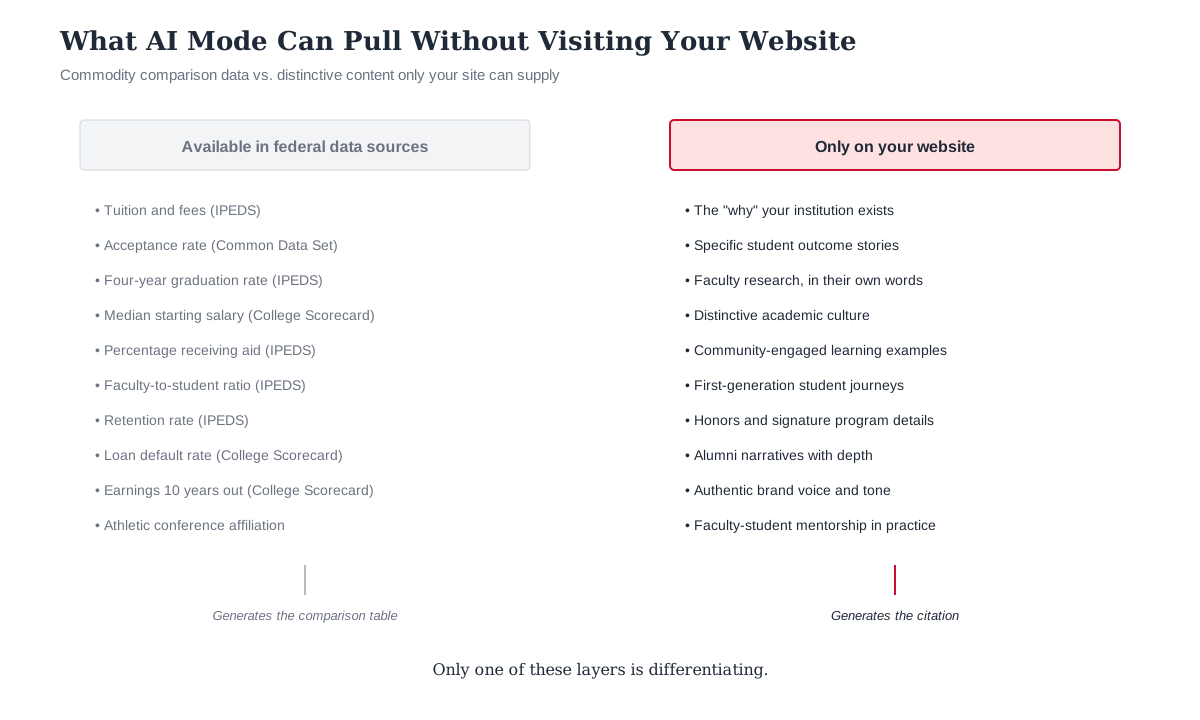
AI Mode can build the comparison table from public data. It cannot generate the story of why a particular student chose your institution, what changed for them while they were there, and where they are now. Only your website can supply that, and only if your website actually contains it.
The commodity layer has already been generated for you. The differentiation layer has to be built by you, written distinctively, and structured to be cited.
The commodity layer has already been generated for you. The differentiation layer has to be built by you. The position is the authentic, distinctive, citable story that lives on your website and nowhere else.
Building the Differentiation Layer
If the answer is not llms.txt files and content chunking schemes, what is the answer for higher ed marketing teams?
It is the work of building the differentiation layer. Putting your institution’s actual brand on the web in a form that cannot be reproduced from a federal database or summarized away by a language model.
Your voice. Your culture. Your specific outcomes. The way your faculty actually talk about their research. The reflections your students actually have about their experience. The way your alumni credit your institution for the trajectory they ended up on. None of it can be interchangeable with the institution down the road, or content a peer could publish with a logo swap.
Content that survives in an AI-mediated search environment has to do four things at once. It has to be clear. It has to be structurally sound. It has to be formatted so the systems that cite it can actually parse it. And it has to be unmistakably, authentically, specifically yours. Strip the first three and you write content AI Mode cannot find. Strip the last and you write content AI Mode has no reason to cite over the version your peer institution already published.
Content has to be clear, structured, well-formatted, AND unmistakably yours.
The authenticity requirement is the keystone of building real institutional authority signals for AI search. Authenticity is the one quality AI Mode cannot manufacture. AI can paraphrase a faculty bio. It cannot reproduce the way that faculty member actually talks about her work. AI can list a study-abroad destination. It cannot reproduce the specific reflection a junior wrote about her semester in Cape Town. The unguarded faculty quotation. The lived student narrative. The alumni story that includes the surprising failure as well as the eventual win. These are what AI Mode has to cite a source for, because AI Mode has no way to invent them.
Authenticity is the one quality AI Mode cannot manufacture.
The practical work is less about technical optimization than about content strategy and brand voice. The Princeton GEO research identifies the structural moves that increase citation rates: inline citations, statistics with named data, direct quotations, structured claim formatting. Those moves are the floor. The ceiling is whether the content beneath the formatting says anything specific, whether the quoted faculty member sounds like a real person, whether the cited outcomes belong to a real student with a name, and whether your brand voice is distinguishable from every other comprehensive regional university in your conference.
Maintain the technical foundation. Pages must be crawlable, indexable, and eligible for snippets to appear in AI Mode at all. Entity-based content organization and consistent semantic structure both feed that foundation. Google’s mythbust list covers the rest: no llms.txt files, no content chunking, no AI-specific rewrites, no buying mentions, no schema as a substitute for substance.
One near-term note. The May 2026 core update will continue to redistribute organic rankings for up to two weeks. Higher ed teams should watch Search Console impression and click data closely through early June.
Start doing the work of becoming uncopyable on the web. Write content worth citing. Make claims worth attributing. Quote faculty and students directly. Tell stories worth pulling into a synthesis.
The Opportunity
The same content moves that win in AI search also win in traditional search. Non-commodity content with specific outcomes, named experts, real data, and clear structure performs in both environments. The hacks Google dismissed never performed in either. Federal data has always shown what every institution has in common. Your website has always been what shows what makes your institution different. AI Mode just made that distinction more consequential.
The institutions that win the next decade of enrollment will be the ones whose websites tell distinctive, specific, citable stories.
The institutions that win the next decade of enrollment and giving will be the ones whose websites tell distinctive, specific, citable stories. The institutions still publishing “7 Reasons to Choose Our University” content in 2027 will find themselves increasingly absent from the answers AI Mode constructs for prospective students.
Google is half right that nothing has changed. The technical foundation has not changed. The fundamental principle that good content wins has not changed.
What has changed is the synthesis layer above traditional ranking, the query patterns AI search invites, the personal context AI Mode incorporates, and the comparison interface AI Mode builds from federal data without consulting your website. The same shifts are taking shape at Perplexity, ChatGPT, Claude, and Meta AI. Higher ed websites built to supply what federal data cannot will be the ones cited across the AI search landscape. Higher ed websites built only to publish what every peer institution also publishes will be the ones quietly summarized around.
That is a craft problem. And it is one higher ed marketing teams can actually solve.
Frequently asked questions
Google’s official position is that generative engine optimization is just SEO. At the technical foundation, that is correct: pages must still be crawlable, indexable, and eligible for snippets to appear in AI Mode at all. The empirical reality is more complex. BrightEdge’s longitudinal study tracked the overlap between AI Overview citations and traditional top-10 organic results moving from 32 percent in mid-2024 to 54 percent in October 2025, then dropping to between 17 and 38 percent in early 2026. Princeton’s GEO research demonstrates that specific content techniques can increase generative engine citation rates by up to 41 percent independent of traditional ranking signals.
No. Google’s mythbust list is genuinely useful. Site owners do not need to create llms.txt files, chunk content for AI consumption, rewrite content specifically for AI systems, pursue inauthentic mentions, or overfocus on structured data as a magic bullet. These tactics have been sold to higher ed teams for two years, and Google’s own guidance now formally dismisses them. What teams should question is the headline framing that nothing has changed. The product changes Google announced at I/O 2026 are substantial, and AI citation behavior has been diverging from traditional ranking since 2024.
Traditional ranking rewards authority and relevance to a single keyword query. AI search citation rewards something different: how well a specific passage answers the synthesized, multi-criteria question the AI is actually trying to satisfy. A page that ranks #8 organically but contains the clearest attributable answer to a compound question can outperform a #1-ranked page optimized for a single keyword. The Princeton GEO research found that lower-ranked sources benefited most from generative engine optimization techniques, suggesting AI citation is partly correcting for the keyword-matching biases of traditional search.
The Princeton GEO research identified adding direct quotations from credible sources as the highest-impact technique, with a 41 percent lift in generative engine visibility. Statistics with attribution, writing fluency, and inline source citations followed at 27 to 31 percent lifts each. The common pattern across all of them: content that provides specific, attributable, structurally clear claims gets cited at substantially higher rates. The single biggest signal is whether your content gives the AI something specific to attribute to your institution.
Each platform draws from a different source mix and weights signals differently. ChatGPT’s web search prioritizes recent, structured content and tends to favor authoritative domains. Perplexity has historically shown high overlap with Google’s top organic results. Google AI Mode draws more heavily from its own index and incorporates Personal Intelligence context from connected Google services like Gmail and Calendar. The common thread is that all three reward clear, structured, attributable content. The differences in source mix mean higher ed teams should test citation footprint across multiple platforms rather than optimizing for one.
Not Sure Where Your Institution Stands?
iFactory’s AI Search Readiness Audit evaluates whether tools like ChatGPT, Perplexity, Google AI Overviews, and Claude can find, understand, and recommend your institution to prospective students.