Some people build careers by following a plan. Others build them by following their curiosity, even when it leads somewhere unexpected.
Curiosity About Creatures
Stanford’s first obsession was animals.
Growing up in Miami, he was in FFA throughout high school, raising farm animals. He studied animal science from elementary school through college. He worked as a vet tech for over five years. The career path seemed obvious: veterinarian.
Then, somewhere along the way, Stanford realized that the answer to “What do I want to be?” wasn’t actually “veterinarian.” The identity he’d built his entire young life around didn’t fit anymore.
“Being a vet was my purpose,” Stanford says. “When I decided that wasn’t for me, I lost who I was.”
Curiosity About Self
What was next? He explored. He tried things. He searched. And somewhere in that uncertain period, he stumbled onto Simon Sinek’s TED talk about starting with why.
Sinek’s whole framework is essentially a curiosity engine. Don’t ask what you do. Don’t even start with how you do it. Start with why. Dig underneath the surface. Keep asking until you hit something real.
“It’s maybe one of the first books I’ve read and actually paid 100% attention while doing so,” Stanford says, “because it was a message I needed at that exact moment.”
The message wasn’t “here’s your new purpose.” It was “here’s permission to keep searching.” To stay curious about yourself even when you don’t have answers yet.
There’s a small Buddhist temple in Gainesville that became part of his exploration. He doesn’t remember exactly how he found it, but he walked in one day, didn’t talk to anyone, and wandered out to the garden area. Sat down. Closed his eyes.
“For a brief moment, I felt nothing… in a good way,” he says. “At that time when my brain felt like it was yelling at me on a daily basis, this felt amazing. Like, this is what peace feels like.”
He still goes back sometimes. Still visualizes that place when he needs to quiet the noise and reconnect with his own thinking.
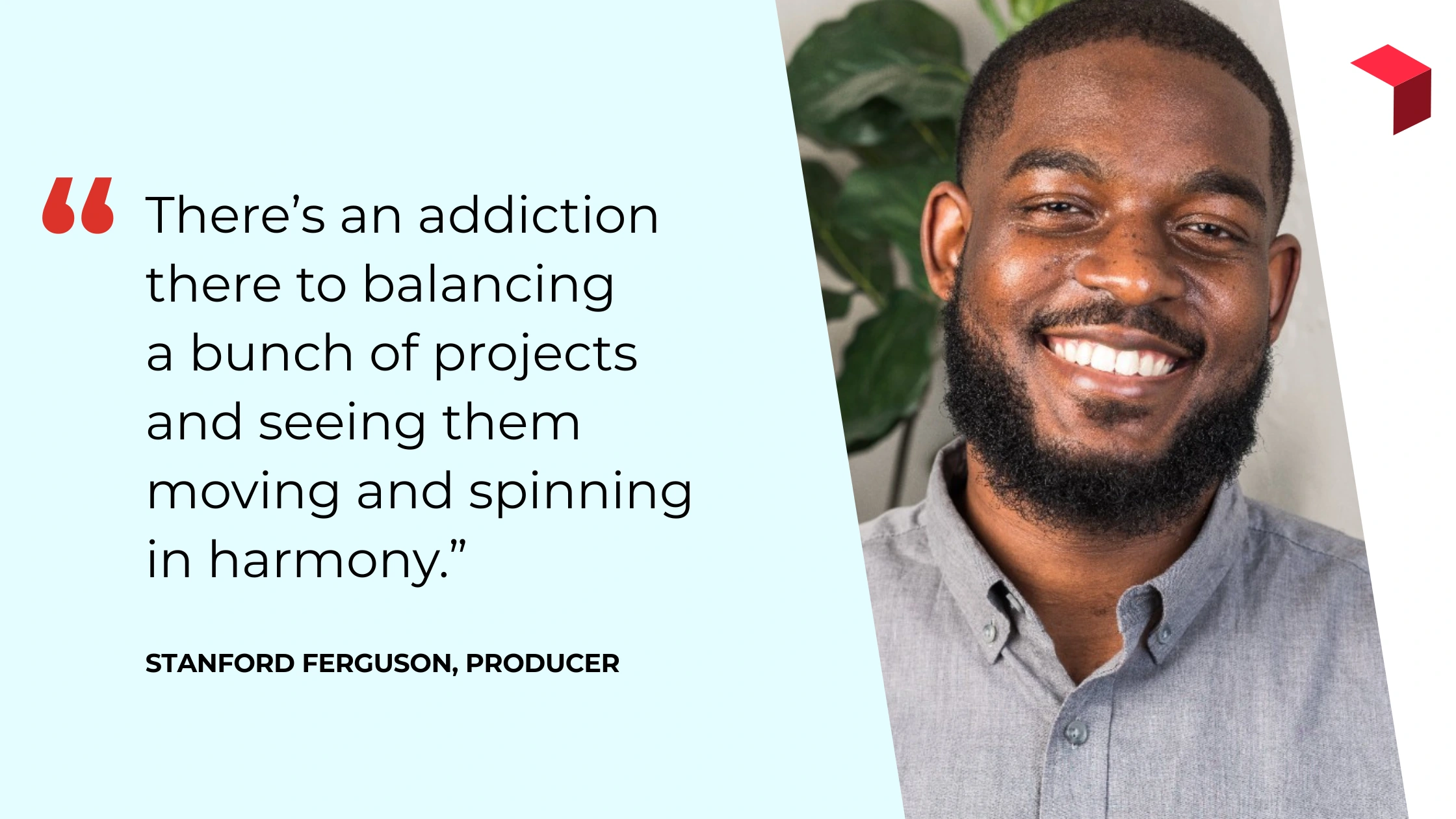
"I kind of get this spinning plates on a stick vibe with work. There's an addiction there to balancing a bunch of projects and seeing them moving and spinning in harmony."
Curiosity About How Things Work
Stanford spent time at agencies, did freelance work, and learned the craft of shepherding complex projects from concept to completion.
Along the way, he discovered something about himself: he has an almost compulsive need to understand how things fit together.
“There’s this sense of needing to organize something placed in front of me,” he explains. “I kind of get this spinning plates on a stick vibe with work. There’s an addiction there to balancing a bunch of projects and seeing them moving and spinning in harmony.”
That’s curiosity applied to systems. How do all these pieces connect? What happens if I adjust this one? Where’s the hidden dependency that’s about to cause problems?
Good project managers aren’t just organized people. They’re curious people, endlessly interested in the mechanics of how ideas become real things. Stanford lights up when he talks about one of his early projects: a construction fence sign for a building UF was constructing.
“I liked it because it was one of the first projects I’ve helped with that I saw the work physically as I drove by,” he says. “Like, this wasn’t an idea anymore. It was an actual design out in the world, and people were looking at it.”
Let’s Be Real
When Stanford was interviewing with agencies, he noticed something different about his conversations with iFactory.
“The thing that sticks out to me now is honestly that extra 10-15 minutes I spent on each interview call,” he says. “I talked with a few agencies, but iFactory really made me feel like that mask I made for work wasn’t needed.”
Anyone who has interviewed knows the mask Stanford is talking about. The professional persona. The polished answers. The careful performance of being the ideal candidate rather than an actual human being with a weird career path and a complicated backstory.
“The calls were only like an hour-ish, so it was brief, but I felt challenged emotionally towards the tail end of each conversation,” Stanford continues. “Like, ‘It’s okay, be yourself.’ I felt comfortable.”
A Few More Things About Stanford
The essential food truth: Pizza is “the best cheese delivery system.” Stanford was always the only one excited about office pizza parties.
The cautionary tale: “I’m not a huge pasta fan anymore. I think I ate it sooo much in college that I ruined it for myself.”
If he could have any superpower: Telekinesis. “Feels like it would be flexible enough to do whatever comes to mind. Would be great for multitasking and day-to-day life.” (The project manager’s superpower—moving multiple things simultaneously without dropping any of them.)
On karaoke: “I have no idea. I am the complete opposite of a karaoke person. I answered this question last and still couldn’t think of anything.” (Some questions don’t have answers, and Stanford is honest enough to say so.)
His idol: Simon Sinek, for obvious reasons. “I’m not perfect and honestly still feel like I struggle with this, but I’m worried about where I would be if I never stumbled on his content at that time.”
Welcome, Stanford
Keep asking questions. Keep following the threads. We’re glad your curiosity led you here.