The Way Students Find You Is Changing
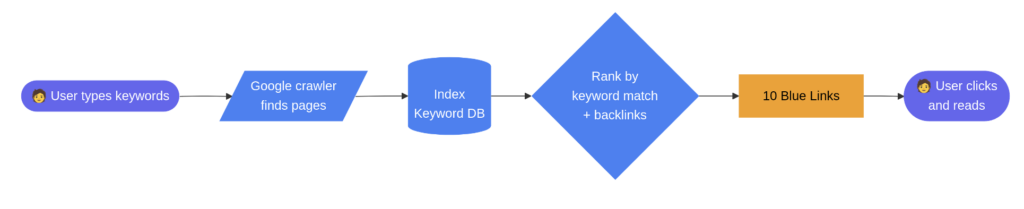
For two decades, the discovery pipeline in higher education has been remarkably consistent: a prospective student types a query into Google, scrolls through ten blue links, clicks on a few, and starts building a consideration set. Organic search still drives 50–75% of visitors to enrollment and program pages at most institutions. That hasn’t changed. (It’s why SEO and GEO optimization remain foundational to any higher ed digital strategy.)
What has changed is the path. Students are increasingly using AI tools like ChatGPT, Claude, Perplexity, and Google AI Overviews as their first step in the college search process. They’re not typing two-word keyword queries. They’re asking nuanced, conversational questions: What are the best online programs for working adults? Which colleges accept life experience for credit? What are the admission requirements for nursing programs near Boston?
And those tools don’t return a list of links. They return a single, synthesized answer, often with citations, sometimes without. If your institution’s content isn’t structured in a way these tools can find, interpret, and trust, you’re invisible in this new discovery channel. That’s where content strategy and technical optimization intersect.
The Zero-Click Reality
Before we get into how AI search works, it helps to understand why this shift matters so much for enrollment marketing.
of Google searches now end without a click to an external website.
Source: Search Engine Land
This isn’t because students stopped searching. It’s because Google’s AI Overviews, People Also Ask boxes, and video carousels are answering questions directly on the results page. Add ChatGPT and Perplexity into the mix, and a growing share of your prospective students are getting answers about your programs without ever visiting your website.
The institutions that show up in those AI-generated answers are the ones that get considered. The ones that don’t, regardless of how beautiful their website is, are starting the enrollment conversation from behind.
How is Your Website's AI Visibility?
How people are finding you is rapidly changing. Our AI Readiness Audit will show you:
- How users are seeing you on key queries
- Your competitive position across platforms
- Actionable next steps
How AI Search Actually Works (And Why It Matters for Your Content)
Traditional SEO was linear. A student typed a query, Google matched it against an index of keywords and backlinks, and returned a ranked list. Your job was to match the right keywords and earn enough links to land on page one.
AI search is fundamentally different. Here’s what happens when a student asks ChatGPT or Google AI Overviews a question like “What’s the best digital marketing program for a liberal arts college?”:
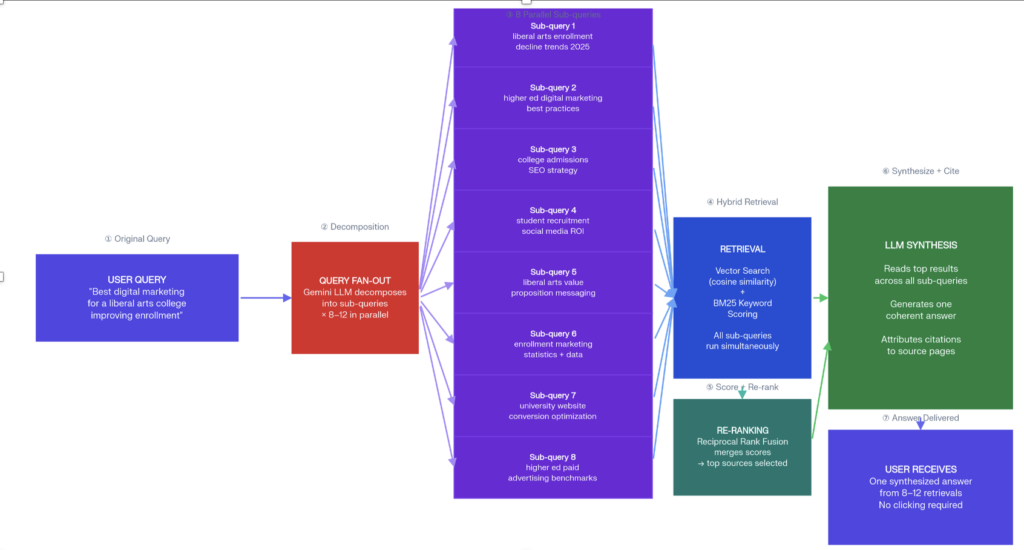
One query becomes many. The AI decomposes that single question into 8–12 parallel sub-queries: liberal arts enrollment trends, digital marketing best practices, college admissions SEO strategy, student recruitment social media ROI, and so on. Each sub-query runs simultaneously against multiple content sources.
Retrieval is hybrid. AI tools use both traditional keyword matching (BM25 scoring) and semantic vector search (cosine similarity) to find relevant content. This means your pages need to be optimized for both exact keyword matches and conceptual relevance. Keyword stuffing won’t cut it, but neither will vague, jargon-heavy copy. (This is one reason research and strategy should precede any content overhaul.)
The AI re-ranks and synthesizes. Results from all sub-queries are merged, scored, and re-ranked. The AI then reads the top sources, generates one coherent answer, and attributes citations to the pages it pulled from. Your content either makes the cut or it doesn’t. There’s no page two.
The key takeaway: In traditional SEO, you competed for a spot on a list of ten links. In AI search, you compete for a mention in a single synthesized paragraph. The bar for content quality, specificity, and structure is higher, but the reward is being the cited authority, not just one link among many.
The Good News: SEO and AISEO Reinforce Each Other
Optimizing for AI search doesn’t mean abandoning everything you’ve done for SEO. The two strategies share the same foundations. Google AI Overviews, for example, overlap with organic search results by 54%. The content that ranks well in traditional search is often the same content that gets cited by AI tools.
Both search engines and AI tools prioritize content that is clear, specific, well-structured, and credible. The difference is that AI tools are more demanding on each of these dimensions. Good SEO gets you in the game. Good AISEO gets you cited. We’ve seen this play out in practice: institutions like North Hennepin Community College saw a 43% organic traffic increase, and San Jacinto College achieved a 54% lift in organic CTR when content was optimized for both traditional and AI search.
So what, specifically, makes content “citable” by AI? Four things.
1. Clear, Specific Messaging
AI tools prefer content that states exactly what a program is, who it’s for, and what outcomes it delivers. They’re looking for the kind of concrete, student-centered language that answers a question directly, not marketing copy that talks around it.
Don’t Do This
Our Accounting program prepares you for a great career.
Do This
The second version includes specific stats, named employers, and a clear outcome. AI tools can extract those facts and cite them. The first version gives them nothing to work with. Developing this kind of outcomes-driven messaging is central to brand strategy work.
2. Structured, Scannable Content
AI systems break down webpages into smaller segments and then identify which specific segments best answer a user’s query. When your content is properly structured, it’s easier for AI to identify and pull the most relevant information.
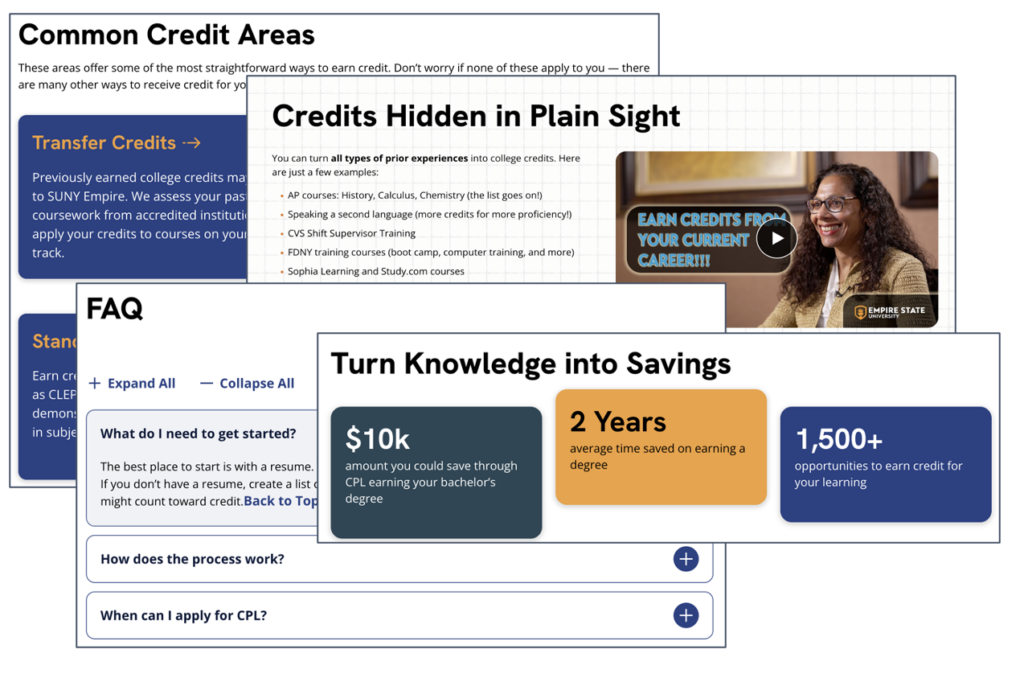
This means using clear headings that describe what each section covers (not clever ones that obscure it), breaking dense paragraphs into focused chunks, adding FAQ sections that mirror the questions students actually ask, and supporting relationships between topics with intentional internal linking. Semantic HTML and topic-based structure matter more now than exact-match keywords. This is where visual design and UX directly impact search performance.
3. Schema Markup and Entity SEO
Schema markup is the structured data you add to your pages. It’s invisible to visitors, but it tells search engines and AI tools exactly what your content represents. For higher education, the most impactful schema types are EducationalOccupationalProgram (for degree and certificate pages), Course (for individual courses), FAQPage (for frequently asked questions), Organization (for institutional identity), and Event (for campus visits, info sessions, deadlines). Implementing these correctly requires coordination between web development and content teams.
Entity SEO is the companion strategy: instead of optimizing for individual keywords, you build topic coverage with semantic variations. A nursing program page shouldn’t just target “nursing degree.” It should also address tuition, cost of attendance, clinical placement sites, NCLEX pass rates, and scholarships. This gives AI tools a complete picture of what your program is, making your content more likely to be cited for any related query.
4. Trust Signals and E-E-A-T
Credibility is the new currency of search. Both Google and AI tools evaluate who’s behind the content, whether it’s been cited or linked to by external sources, and whether the institution demonstrates genuine expertise on the topic.
For higher education, you have a built-in advantage here: .edu domains carry inherent authority. But that’s a starting point, not a strategy. Building on that foundation through measurement and analytics helps you see which trust signals are actually driving results. Earning press mentions, maintaining directory listings, publishing thought leadership in external publications, and using consistent program names across all platforms all strengthen the trust signals that make AI tools more likely to cite you.
Time to Pay Down the Content Debt
AI crawlers do not reliably respect robots.txt. They can and will find everything on your domain, including content you thought was hidden or archived.
That means old tuition PDFs with outdated fee charts still get surfaced. Archived program materials and syllabi from discontinued courses can appear in AI answers. Inactive student blogs or club pages from three years ago create confusion. COVID-era policies and withdrawn forms still get indexed and cited as current fact. A thorough accessibility and content audit catches these issues before AI does.
If it exists on your domain, AI will find it and may cite it as fact. A content audit isn't just an SEO hygiene exercise anymore. It's a reputation management necessity. Every outdated page is a potential source of misinformation about your institution, served up with confidence by an AI tool.
Where to Start: A Practical AISEO Checklist for Your Institution
You don’t need to overhaul your entire website to start showing up in AI search results. But you do need to be intentional about a few high-impact changes. Here’s a prioritized starting point:
Content & Messaging
- Rewrite program page intros to lead with outcomes. Open every program page with a 40-to-60 word paragraph that directly answers “What is this program and why should I choose it?” Include specific numbers: graduation rates, employment rates, salary data, class sizes.
- Add FAQ sections to your highest-traffic pages. Write them in the language students use, not the language your catalog uses. “How much does this program cost?” beats “Tuition and Fee Schedule.”
- Audit and remove outdated content. Prioritize: old tuition PDFs, archived program pages, COVID-era policies, and inactive student org pages. If you can’t remove it, add clear “archived” labels and dates.
- Replace jargon with student-centered language. Write for decisions, not brochures. Align content with how students phrase their questions.
Technical & Schema
- Add EducationalOccupationalProgram schema to every degree and certificate page. Include fields for provider, time to complete, salary upon completion, and occupational category.
- Add FAQPage schema to any page with a question-and-answer format. This directly feeds AI Overviews and featured snippets.
- Ensure Organization schema is on your homepage with consistent name, address, sameAs links to social profiles, and accreditation details.
- Check page speed. AI tools and Google both favor fast-loading pages. Run Core Web Vitals on your top 20 pages and fix anything red.
Trust & Authority
- Build entity consistency. Make sure your institution’s name, program names, and campus locations are identical across your website, Google Business Profile, directory listings, and social media.
- Earn external mentions. Publish thought leadership on external platforms. Get listed in program-specific directories. Pursue press coverage for unique outcomes or partnerships.
- Strengthen internal linking. Every program page should link to related outcomes data, student stories, faculty profiles, and application pages. AI uses link structure to understand relationships between content.
Not Sure Where Your Institution Stands?
iFactory’s AI Search Readiness Audit evaluates whether tools like ChatGPT, Perplexity, Google AI Overviews, and Claude can find, understand, and recommend your institution to prospective students.
The Bottom Line
AI search isn’t replacing traditional SEO. It’s layering on top of it. The institutions that will win in this new landscape are the ones that do what great SEO has always required (clear content, strong structure, genuine authority) and go one step further: making that content specific enough, structured enough, and trustworthy enough for AI tools to cite with confidence.
The good news is that these optimizations benefit both channels. Better program page copy improves your Google rankings and your AI citation rate. Schema markup feeds featured snippets and AI Overviews. A content audit cleans up your search presence and prevents AI from citing outdated information about your institution.
Start with one program page. Rewrite the intro, add the schema, clean up the stale content around it, and see what happens. (Not sure where to begin? Our case studies show how other institutions have approached this.) The institutions that treat AISEO as a natural evolution of their search strategy, not a separate initiative, are the ones that will own the next generation of student discovery.