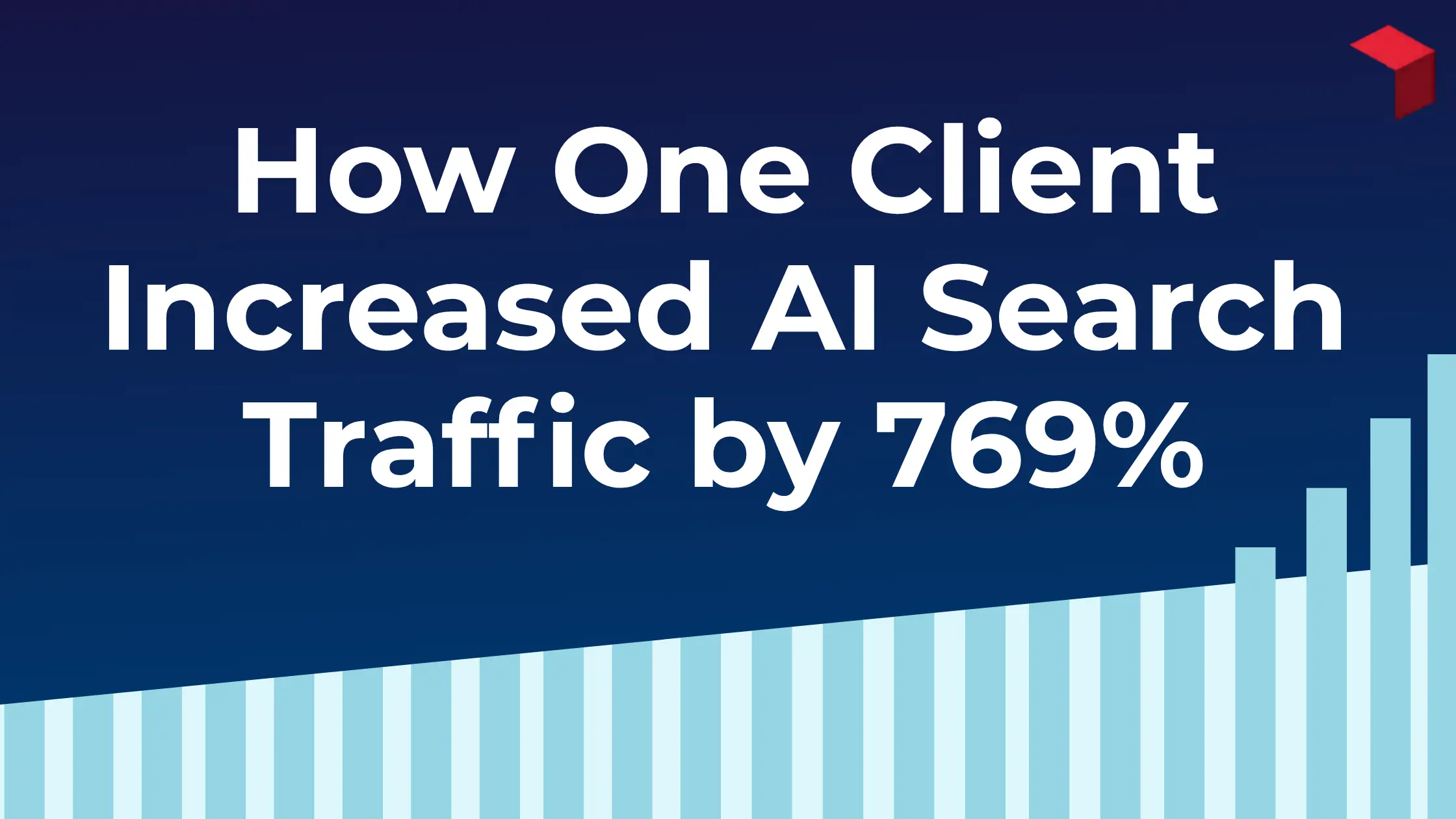
Traffic from AI search to one of our higher ed clients grew 769% year over year in July. Over the same period their AI citations went from 538 to 833, their mentions across ChatGPT, Google AI Overviews, and Google AI Mode went from 502 to 724, and their organic click-through rate came in at 10.35%.
What makes the project so extraordinary is how ordinary the work was. The university kept its platform, kept its site, and bought no AI tooling. It had a dated site structure, a marketing team of a handful of people, and about a year of deliberate cleanup.
What makes the project so extraordinary is how ordinary the work was.
About the institution
This is a regional public university in the Midwest with roughly 5,000 students, strongest in allied health, education, and business. The marketing and web team is small enough that everyone covers more than one role.
They originally came to us with an analytics problem.
They did not trust their own numbers, and they could not report website performance back to deans and university leadership with much confidence.
The SEO and AI visibility work grew out of that problem, which turned out to be the right sequence.
Fix the measurement first. Then you can make SEO and content decisions using evidence instead of assumptions.
Fix the measurement first. Then you can make SEO and content decisions using evidence instead of assumptions.
The SEO Problem: Organic Traffic Was Mostly Branded
This is the finding we see with a lot of institutions.
Roughly 83% of their organic traffic was branded. People typing the school’s name, or the name of the learning management system, or the email service name, or the campus map. Those visitors are current students, faculty, and staff. They use the website as a filing cabinet, but it inflates every traffic number on the dashboard while contributing nothing to recruitment.
The structural evidence was hard to argue with:
- The homepage absorbed 61.7% of organic traffic. Prospective students were landing on the homepage rather than on the program page that answered their question.
- The admissions subdomain accounted for 0.97% of organic traffic. Under one percent, for the section of the site whose entire purpose is enrollment.
- Landing pages for current students and for faculty and staff ranked among the highest-traffic pages on the site.
- Homepage new users had declined from roughly 35,000 in 2023 to about 24,000 in 2025.
One number was moving in the right direction. Non-branded traffic was up 22% year over year, the only category growing, which told us the demand was real and the site was capturing a fraction of it.
Report branded and non-branded traffic separately, every month. A single organic sessions number can hide a recruitment and funnel problem.
Fix the measurement first. Then you can make SEO and content decisions using evidence instead of assumptions.
The Keyword Opportunity: Hundreds of Rankings Were Within Striking Distance
We pulled 4,766 academic and program keywords. The distribution looked like this:
- 532 keywords in the top 10, about 11% of the set, carrying roughly 120,790 monthly searches
- 527 keywords in positions 11 through 20, carrying roughly 87,830 monthly searches
- 1,515 keywords in positions 21 through 50
- 2,192 keywords below position 50, carrying roughly 498,000 monthly searches
Average keyword difficulty across the opportunity set was about 26. For a regional public university, 26 is winnable. These were program terms the school already had authority for, sitting one page away from the traffic.
The individual examples were more useful than the totals.
An allied health program page ranked around position 80 for a term with 49,500 monthly searches.
A graduate health administration page ranked first for the exact program name but eighteenth when “online” was added to the query. That distinction matters because prospective students frequently qualify program searches by delivery format.
A technology program ranked around position 17 for a term with approximately 3,600 monthly searches, putting it within striking distance of page one.
Then we found something stranger.
A decades-old academic handout, a PDF created for a course and never intended as recruitment content, ranked at position 44 for a history term with 22,200 monthly searches. Several misspellings of the same term ranked as well.
That was a useful signal. Legacy academic content was earning search visibility while more important recruitment content remained difficult to find.
A decades-old academic handout, a PDF created, ranked at position 44
How to Rank in AI Overviews: What the Cited Pages Had in Common
We scored their AI visibility at 39 out of 100 on the Semrush scale, which reads as medium. Real presence across a narrow range of topics.
The interesting part was where the citations came from. AI systems were citing the university’s library research guides and a few graduate program pages, and citing almost nothing on admissions, cost, or online program availability, which are the questions students actually ask an AI assistant.
A meaningful share of those citations also pointed at the library subdomain rather than the main institutional domain, so the authority was accumulating in a place that does no recruiting.
We looked at what the cited pages had in common. Three traits, consistently:
- A clear H1 that named the thing the page was about.
- Structured question-and-answer content on the page.
- Answer-first writing. The page said what the program was in the first paragraph, ahead of any welcome message.
Librarians had written those guides for students, in plain language, with headings that matched real questions, and those headings are what made them quotable. The program pages read as catalog copy, and catalog copy gives an AI system nothing to lift.
So the most AI-friendly content on this university’s website came from people who had never thought about AI at all. They answered questions clearly.
How We Improved SEO and AI Visibility
The work fell into four areas. We sequenced it so the measurement came first, because otherwise you cannot prove any of the rest of it worked.
Fix analytics and enrollment measurement
We audited the GA4 and Google Tag Manager configuration and found duplicate containers, paused recruitment pixels, and no custom events for any enrollment action. Apply clicks, information requests, and campus visit requests were invisible. We cleaned up the tracking, rebuilt the measurement structure around enrollment KPIs, and set 2025 as the formal baseline year. Then we built reporting views by department, by program, and by recruitment action, so the team could report performance back to departments and university leadership without rebuilding a spreadsheet every month.
Create a repeatable SEO structure for program pages
We gave the team a repeatable pattern for the priority program pages. A title tag that leads with the program name and ends with the institution. A 150 to 200 word opening paragraph that states the credential, the program, the institution, and the location in plain sentences. Scannable H2 sections for Admission Requirements, Program Length, Cost and Financial Aid, Careers After Graduation, and How to Apply. Then three to five internal links pointing at each page from its parent hub.
That opening paragraph is doing more work than it looks like. When a page says “[University] offers a Bachelor of Science in Environmental Science on its campus in [City, State],” an AI system has the provider, the credential, the subject, and the place in one sentence. When the page opens with “Welcome to our nationally recognized program,” it has nothing to work with.
Improve entity clarity on tuition and admissions pages
Their tuition page was ranking for other universities’ tuition queries, because its H1 said “Tuition” and nothing else. Google had no way to know whose tuition it was. Naming the institution in that H1 fixes a problem that had been quietly wasting the page for years, and the same fix applies to scholarships, admissions, and the graduate and undergraduate index pages.
Clean up indexing and technical performance
The legacy PDFs and non-recruitment handouts needed to move or get a noindex tag. On the performance side, the homepage was loading five separate render-blocking stylesheets, including ones for newsroom, events, faculty, and policies sections that do not appear on the homepage. Lighthouse estimated 20 to 22 seconds of mobile savings from that alone. The hero image on one program page ran 699KB with no caching and no modern format. Two tag manager containers were firing, plus separate social and chat scripts, all of it before the page rendered anything a visitor could see.
AI Visibility Results: Citations Increased 55%
Comparing the 2025 baseline with 2026, after the project:
Measure | Before | After |
|---|---|---|
| AI mentions | 502 | 724 |
| AI citations | 538 | 833 |
| Cited pages | 401 | 455 |
Traffic from AI search grew 769% year over year in July 2026, and organic search click-through rate reached 10.35% that same month.
Citations grew 55% and mentions grew 44%, and that is the durable part. If you are working out which of these numbers belong in your reporting, citations are the one I would put in front of leadership. Cited pages grew 13%, which is slower, and tells me the gains concentrated in pages that were already close rather than opening whole new sections of the site. The 769% is real and it is also a small base getting larger, so the citation numbers are the ones I would show you.
This is one institution over one academic cycle, and AI search itself changed during that period. We are confident the structural work caused the citation growth, because the pages that gained citations are the ones this work restructured. We would not promise anyone a specific percentage.
7 Ways to Improve Your University’s AI Overview Visibility
- Split branded from non-branded in your organic reporting and look at the ratio. If branded is above 75%, I would treat that as a recruitment problem. Your site is serving current students, and your recruitment content is not being found.
- Pull your striking distance keywords, everything in positions 11 through 20, and sort by search volume. That list is your next quarter of work. On-page changes move those, and nothing else you do will have a better effort-to-result ratio.
- Check the H1 on your tuition page. If it says “Tuition” without your institution’s name, you are competing with every other school in your state for your own cost information.
- Open your top five program pages and read the first paragraph out loud. If it does not say what the credential is, who offers it, and where, rewrite it. That paragraph is what AI systems quote.
- Take the “People Also Ask” questions from Google Search Console for your program terms and answer five to eight of them at the bottom of each program page, in the students’ own phrasing, with FAQ schema. This improves traditional rankings and AI citations at the same time, which is rare.
- Audit your PDFs. Search site:yourschool.edu filetype:pdf and look at what comes back. If old course handouts are outranking your programs, move them or noindex them.
- Confirm you are tracking apply clicks, information requests, and campus visit requests as events. Without those, you cannot measure anything above, and you will spend next year arguing about opinions.
SEO Fundamentals Are Becoming AI Search Fundamentals
The agentic web is coming and it is going to change how students find schools completely. What this project convinced us of is that preparing for it looks a lot like doing the fundamentals well: clear headings, direct answers, one page that is obviously the definitive page on a subject, structured data, and internal links that make the hierarchy legible.
Those are the same things that made a site work in 2015, applied with more discipline and less tolerance for ambiguity, because an AI system will not infer what a human visitor would infer.
If you want to talk through what this would look like at your institution, we am glad to look at your site first and share what we find before any conversation about scope. That is typically how we start, and it is the front end of our AI visibility work. We will write up what we see and send it over.
Frequently Asked Questions About AI Overviews and AI Visibility
Semrush scores AI visibility from 0 to 100. This university started at 39, which the tool reads as medium. There is no published benchmark for higher education, so the useful question is direction rather than threshold. We set a target of 50 or better within six months and tracked it monthly against the 2025 baseline.
The pages already earning citations on this site shared three traits: a clear H1 that named the subject of the page, structured question-and-answer content, and an opening paragraph that answered the question before saying anything else. Adding those three things to program and admissions pages is the most direct route.
A mention is the institution being named in an AI answer. A citation is one of your own pages being used as a source for that answer. Both moved here, mentions from 502 to 724 and citations from 538 to 833, and citations are the number worth reporting, because a citation means your page did the work.
Because current students, faculty, and staff use the website as a resource all year, searching the institution’s name plus a system or a map. Those visits are real and they inflate the traffic total. At this university branded traffic was roughly 83%. Report branded and non-branded separately or the recruitment picture stays hidden.
This engagement ran about a year, from the 2025 baseline to the 2026 measurement. That is one institution over one academic cycle, during a period when AI search itself was changing, so treat it as a data point rather than a timeline you can count on.