Google's CEO keeps describing search as a manager of agents
Back in April, Sundar Pichai sat down with John Collison and Elad Gil for a long interview, and somewhere in the middle of it he said something that outlined the future of search, “A lot of what are just information-seeking queries will be agentic in Search. You’ll be completing tasks. You’ll have many threads running. Search would be an agent manager in which you’re doing a lot of things.”
In a separate conversation with Nilay Patel at The Verge, he said that agents are “the next evolution of the web” and that it “will evolve the web pretty profoundly.” He also said, when asked whether Google’s search box, its app-building tools, and its agent products should become one product: “It will.”
And then last week he said it again. On Alex Heath’s Sources podcast he described Search, Gemini, and Google’s new Spark personal agent running on “the same model, same harness, same runtime,” with the agents providing “that unifying experience across these products.” His words for where it ends up: “Our vision in the near future is it’s one box.” He also mentioned, almost in passing, that he now has agents running 24/7 that summarize what is happening across Google for him, so he is not describing a product roadmap so much as how he already works.
The SEO press has covered all of this, mostly through a commerce lens. Shopping, booking, comparing prices. But we have not seen much written about what agentic search means if you run a university, a hospital system, or a nonprofit, and your website is the thing that gets people to apply, book an appointment, or give. So that is what we want to do here. Not a prediction, because frankly we do not know the timeline. More of a what-does-this-change-if-he-is-right.
What "agent manager" actually means.
For 25 years, search has been like a librarian. You ask, it hands you a list of places to look, and you go do the looking. You get the click, you get the visitor, and then your site has a job to do.
What Pichai is describing is different. You ask search to do a thing, not find a thing. “Figure out which of these three nursing programs I can finish part-time by 2028 and tell me what it will cost.” Search spins up a few agents, they go read the program pages, the tuition pages, the transfer credit policy, the calendar, and they come back with an answer. Several of those tasks can be running at once, which is the “many threads” part. Search becomes the thing that assigns the work and keeps track of it. Hence, agent manager.
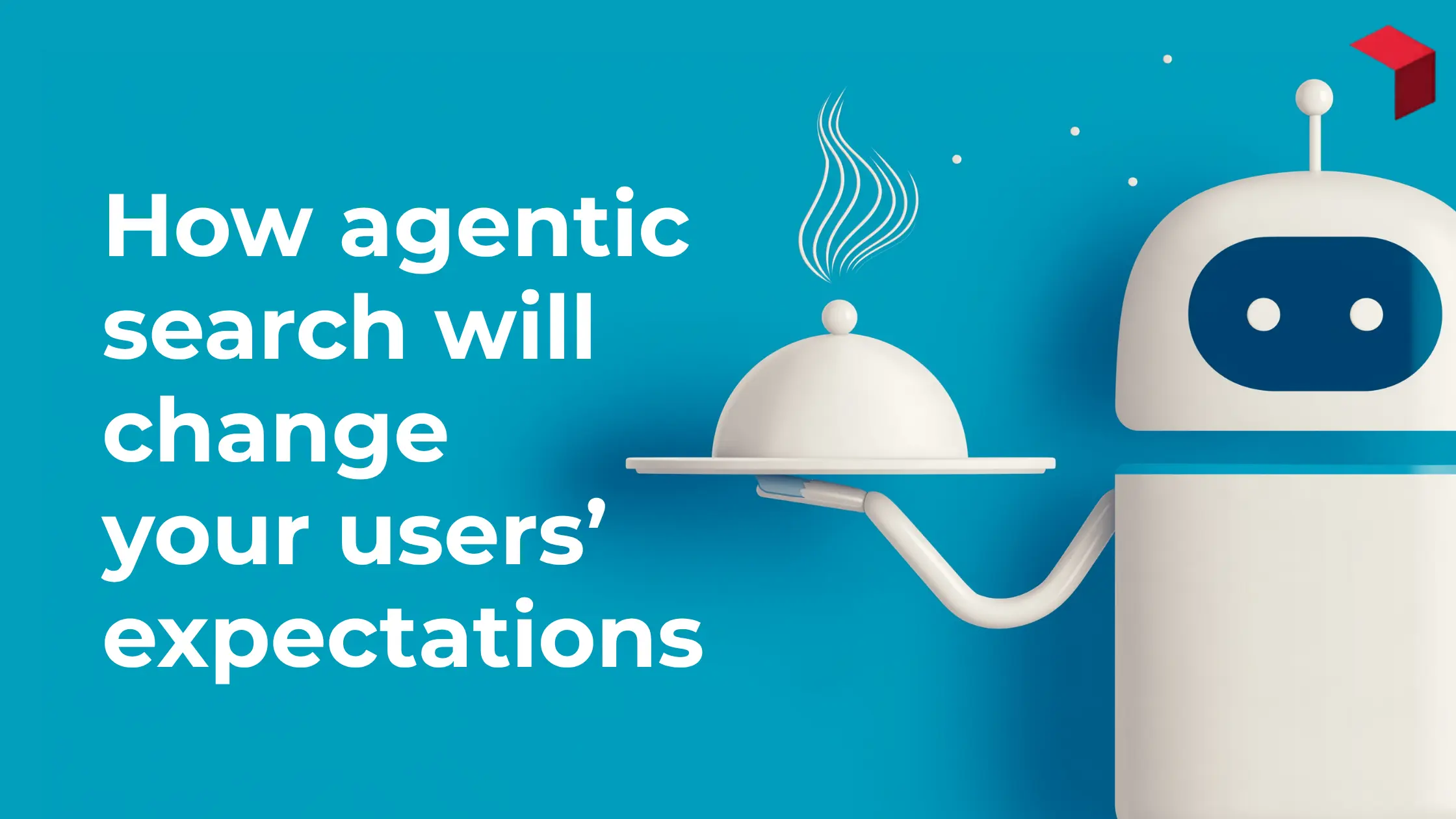
So, first thing to consider is that the visitor in that scenario is not a person. It is software, reading your site on a person’s behalf, and it does not care about your gorgeous hero image or lovely illustrations. The second is that the person may never arrive at all. They get the answer where they asked the question, and your site did its job without ever getting the click. An this scenario totally changes how we think about websites and measurement.
The visitor in that scenario is not a person. It is software, reading your site on a person's behalf, and it does not care about your hero image.
Is it here yet? Not really. Google AI Mode is still not the default search experience, and Pichai himself pointed at 2027 as the inflection point for some of this. But the direction is not ambiguous. He said Google is “laying a lot of the primitives” for agents to work end to end. We would take him at his word on that.
For universities: the agent is going to read your program pages before the student does
The prospective student journey has always been a research project. Compare programs, compare cost, figure out deadlines, figure out whether the credits transfer, and then, finally, request information or apply. Schools agonize over how to create a wonderful journey for a user that is exploring options. That exploration and research may someday be performed by an agent.
Imagine a student who knows what they want, and can articulate it to an agent: “Which schools within two hours of Hartford have an accredited MSW I can do while working, and what is the real cost after aid?” The agents go out and read. If your program page has the format (online, hybrid, evening), the length, the accreditation, the tuition, and the application deadline, written clearly and marked up so a machine can find it, you should be in the answer. And if that information isn’t stated really clearly, maybe it is written as “flexible learning options designed around your life,” you are probably not going to show up.
Sometimes schools have program pages that describe the vibe and the pedagogy, but not the facts. Tuition is often in a different site section program, with no connection between the two. Deadlines are sometimes in a calendar system and not easily found by an agent.
The schools with clean, structured, honest program data are going to be the ones in the conversation when it starts.
And then there is the really wild part. If the student gets the comparison without visiting, they soon may be able to complete a request-for-information form through an agent as well. We do not know what admissions funnels look like in that world. What we do know is that the schools with clean, structured, program data are going to be showing up for ‘comparison shoppers.’
For healthcare providers: find-a-doctor is about to get a new user
Some sites have one job above all the others, and it is getting a person to the right clinician at the right location with an appointment they can book. Everything else on the site is gravy. That one job is also the single most agent-shaped task we can think of.
“Find me a pediatric dermatologist within 20 miles who takes my insurance and has something open in the next two weeks.” Today that is some searching and possibly a phone call. In the world Pichai is describing, the agents read your provider directory, your locations, your insurance list, and ideally your scheduling availability, and bring back a shortlist. The person picks one. That is the whole interaction.
Can a machine read your provider directory? And all of the details like the insurance accepted list? Are the locations clear? How easy is it to request an appointment. A human can muddle through some less than ideal structures. An agent cannot.
A human can muddle through that. An agent cannot, and it will not try very hard.
The other thing that matters is trust. An agent deciding what to tell someone about is going to weight sources that look authoritative, current, and consistent. Author bylines on clinical content, review dates, clear organization pages, and the same facts repeated the same way everywhere on the site. That is not new advice. That has always been important for SEO. It just gets a lot harder to ignore when the reader is software deciding whether to cite you or your competitor.
For mission-driven nonprofits: own the narrative, because the agent will tell it for you
Nonprofits are in a slightly different spot, because a lot of what you need from a website is not transactional. It is persuasion. Someone needs to understand what you do and why it matters before they give, volunteer, or show up.
We think the agent manager cuts both ways for nonprofits. The transactional side is good news. “Find me a food bank near Worcester that takes volunteers on Saturdays” or “which local organizations working on housing have a four-star rating and accept donor-advised funds” are tasks an agent can complete, and the organizations with clear, structured program, location, and giving information will show up in those answers. Small organizations that could never win a search ranking against a national brand may do fine when the question is specific and local.
If the donor’s first encounter with your mission is an agent summarizing you in two sentences, those two sentences are coming from somewhere. Your site, your Candid profile, your 990, a news story from four years ago, a Reddit thread. If you have not written the clear, specific version of what you do and who it is for, the agent will assemble one, and it will be a little bit wrong. We would much rather the summary come from you. That means a clear about page, program pages that say what happens and to whom and with what result, and impact numbers that are current and stated the same way everywhere.
If you have not written the plain, specific version of what you do and who it is for, the agent will assemble one, and it will be a little bit wrong.
And the stories still matter. People give because of people. The agent gets someone to your door, and once a human is there, the site needs to be more than machine readable. It needs to move them. That part does not go away. We think it gets more important, because by the time the person arrives, the comparing has already happened and the story is what is left to decide on.
What to do about it now, in crawl-walk-run order
We are not going to tell you to rebuild your website for agents. Nobody knows enough yet to justify that, and we would be a little suspicious of anyone selling it. What we would do is the unglamorous stuff that pays off for more traditional SEO and AISEO anyway.
“Crawl” is getting your facts straight. Pick the five to ten pages that carry your institution’s real decisions (programs and tuition, providers and locations, programs and giving) and make sure the facts on them are current, specific, and identical everywhere they appear. This is a content job, not a technology project, and it is typically the thing that is most inconsistant when we audit a site.
This is a content job, not a technology job.
“Walk” is making facts machine readable. Put schema markup on key pages that matter, so the thing you say in a paragraph is also said in a form software can read easily. Schema such as: Course, EducationalOccupationalProgram, Physician, MedicalOrganization, NGO, Event, FAQ can really help. Write clean headings that match what people ask. Create a senible sitemap with clear naming conventions. People call this AI search engine optimization or GEO. Google says it is just SEO, which is half true. We would call it site hygene.
“Run” is where it gets speculative, and we would hold off on most of it. Exposing availability, scheduling, or application status through something an agent could act on. Measuring what you cannot see, because a task completed inside search leaves no visit in your analytics. We are experimenting with this with a few clients and we do not have a clean answer on measurement yet. When we do, we will write it up.
If you want a sense of your AI visibility today, this is roughly what our AI Visibility Sprint looks at. It is a short engagement, not a redesign, and it ends with a list rather than a proposal.
What's worth a conversation
The thing we keep coming back to is the sentence about many threads running. If agentic search lands the way he describes, the websites that do well will be the ones that answer a direct question with a verifiable fact, in a form both a person and a machine can read. Human AND machine readable. .
So we are curious. What is the one task on your site that, if an agent did it on a prospective student’s or patient’s or donor’s behalf, would change how you think about the whole thing? We would really like to hear it, and if it is useful, we are happy to crawl your site and tell you what an agent would find today. Just let us know.
Not Sure Where Your Institution Stands?
iFactory’s AI Search Readiness Audit evaluates whether tools like ChatGPT, Perplexity, Google AI Overviews, and Claude can find, understand, and recommend your institution to prospective students.
Frequently asked questions about agentic search
He means that instead of returning a list of links, Google Search will take on tasks. You ask it to compare, book, or figure something out, it assigns the work to AI agents that read websites on your behalf, and it keeps several of those tasks running at once. He described it in an April 2026 interview and again on the Sources podcast in October 2026.
Not as the default. Google AI Mode exists but is not the default search experience, and Pichai has pointed at 2027 as an inflection point for some agent capabilities. The direction is clear; the timeline is not.
Get the facts on your program pages straight and consistent: format, length, accreditation, tuition, and deadlines, written plainly rather than buried in PDFs. Then add schema markup so software can read those facts without guessing. That work also helps you show up in AI Overviews today.
Probably, for research-type questions, because the person gets the answer where they asked it. That makes measurement harder, since a task completed inside search leaves no visit in your analytics. We do not have a clean answer on measuring that yet, and we are wary of anyone who claims to.